
Technologies Used
Digital Transformation Case Study
From Manual Buyer Research to an AI-Assisted Deal Execution Engine
How HeitechSoft helped an M&A Advisory Company transform day-to-day deal execution with a production-ready buyer matching platform.
The Challenge
For an M&A Advisory Company, speed and precision are not administrative luxuries. They directly affect deal momentum, buyer engagement, advisor productivity, and the quality of the transaction process.
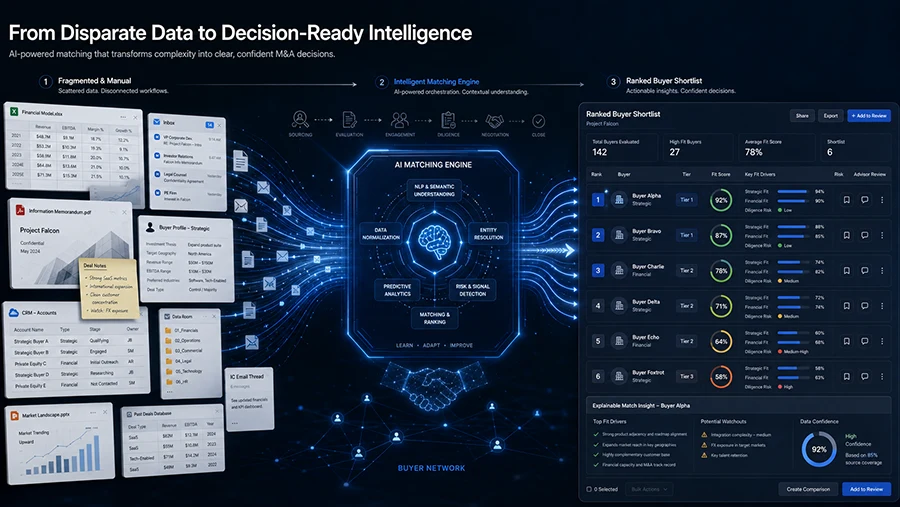
Before HeitechSoft’s involvement, the firm’s buyer matching process depended heavily on manual research, fragmented records, spreadsheets, inbox history, PDFs, CRM notes, and individual advisor knowledge. The business had valuable expertise, but too much of that expertise lived outside a repeatable system.
For every new sell-side mandate, advisors had to reconstruct the buyer universe manually. They reviewed historic buyer lists, interpreted notes, checked previous outreach, assessed industry fit, considered geography, looked at deal size, and tried to remember which buyers had previously shown interest in similar opportunities.
“The problem was not a lack of expertise. The problem was that too much expertise was trapped in manual work.”
That approach worked when volume was lower and the process could rely on individual memory. But as the business grew, the old method became expensive. Not because the team lacked skill, but because the workflow forced skilled people to spend too much time doing work that software and AI could support better.
A High-Value Process Running on Low-Leverage Tools
Buyer matching is one of the most important operational activities in an M&A advisory firm. A weak shortlist can slow outreach, miss qualified buyers, reduce competitive tension, and weaken deal outcomes. A strong shortlist can accelerate conversations, improve buyer response quality, and help advisors focus their time where it matters.
The firm’s original process had several limitations.
First, buyer discovery was slow. Advisors and associates had to search through disconnected information sources to determine who might be relevant for a new deal. A shortlist that should have been available quickly could take hours of manual review.
Second, match quality was inconsistent. Different advisors could evaluate the same deal and arrive at different buyer lists because the criteria were not fully standardized. Industry fit, EBITDA range, geography, business model, prior activity, and buyer history were being interpreted manually rather than applied through a consistent scoring model.
Third, institutional knowledge was fragile. If an advisor remembered a buyer’s preference, that knowledge helped. If the information was buried in a note, old email, or spreadsheet, it could easily be missed. The business was relying on human memory to do the job of an operating system.
Fourth, there was limited explainability. When a buyer appeared on a shortlist, it was not always easy to show exactly why they were included, what criteria they matched, what risk indicators existed, or when they were last contacted.
“In a deal business, slow information is expensive information.”
For an advisory business, that creates real operational drag. It increases cost, slows execution, and makes it harder to scale the firm’s best judgment across the whole team.
The HeitechSoft Solution
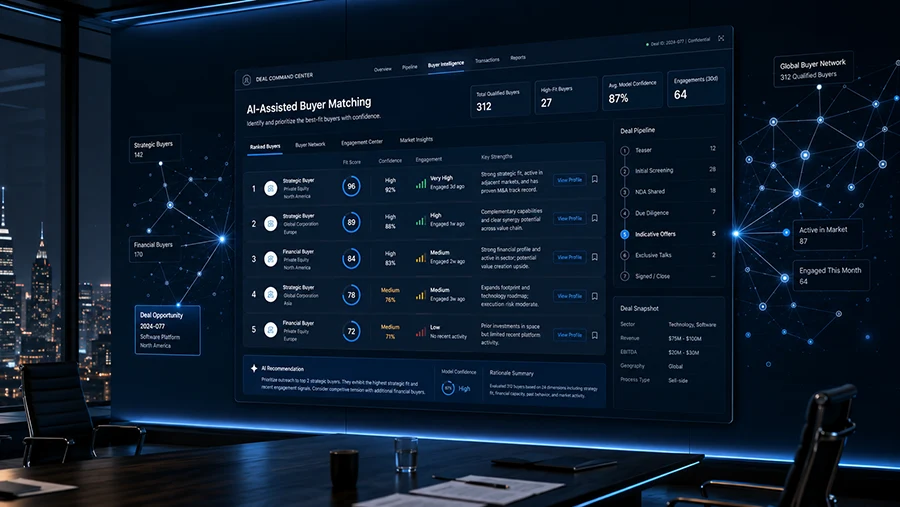
HeitechSoft designed and built a production-ready AI-assisted buyer matching platform that transforms buyer discovery from a manual research task into a structured deal execution workflow.
The system centralizes buyer and deal intelligence, applies matching logic, ranks potential buyers, explains the reasoning behind each match, and gives advisors a clear interface to review, adjust, and act.
At the core of the platform is a structured matching engine built around two levels of decision-making.
The first layer applies hard filters. These remove buyers that do not meet critical requirements such as active status, industry exclusions, size range, geography, and other non-negotiable constraints.
The second layer applies weighted scoring. Buyers who pass the hard filters are ranked using a 0–100 fit score across factors such as industry alignment, deal size, EBITDA range, geography, business model, acquisition history, recency of contact, and engagement signals.
The result is not just a list. It is an advisor-grade recommendation workflow.
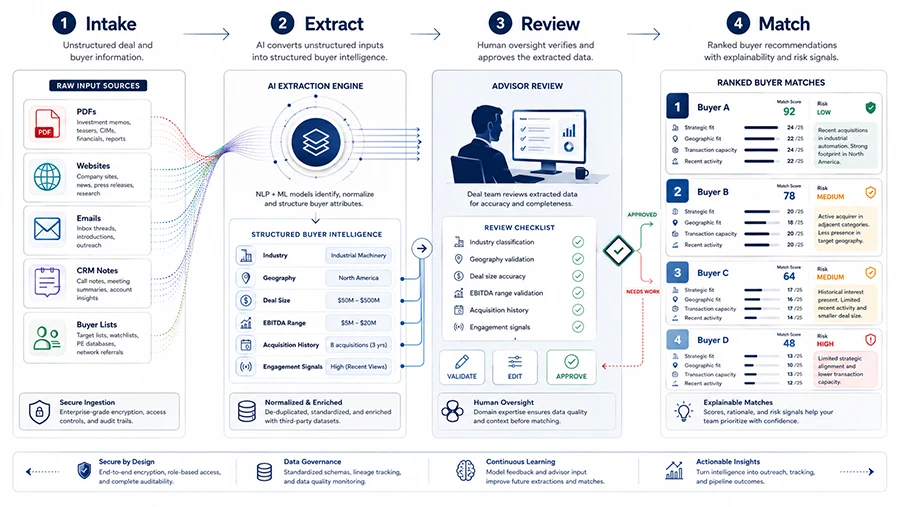
Each buyer match includes a plain-English explanation, component-level score breakdowns, and risk indicators. Advisors can understand why a buyer was recommended, what made the match strong or weak, and whether the buyer should move forward in the outreach process.
“The platform does not just answer ‘who should we call?’ It explains why.”
AI Where It Belongs: Inside the Workflow
This project was not about bolting AI onto an old process for marketing value. It was about using AI where it creates leverage.
The system uses AI-assisted ingestion to help turn unstructured buyer and deal information into structured, usable data. Buyer documents, web content, notes, PDFs, and free text can be processed into fields such as industry focus, geography, transaction size, EBITDA profile, acquisition preferences, and other matching attributes.
But HeitechSoft deliberately kept human judgment in the loop. Extracted information flows through an advisor review process before it is applied to the database. Advisors remain in control of final data quality, while AI handles the heavy lifting of extraction, organization, and initial interpretation.
That design matters. In M&A, blind automation is dangerous. The right model is not “AI replaces the advisor.” The right model is “AI increases the advisor’s leverage.”
“The win was not replacing judgment. The win was giving judgment a better operating system.”
HeitechSoft also used AI-supported development practices to accelerate implementation. By applying AI during the build process itself, HeitechSoft was able to deliver a highly specialized platform more efficiently than traditional custom software delivery would typically allow. That means lower development cost, faster production readiness, and a stronger return on the client’s investment.
The Day-to-Day Transformation
The biggest value of this project is not one feature. It is the change in how the business operates.
Before the system, the firm’s buyer matching process was largely manual, fragmented, and dependent on individual effort.
After the system, the firm has a centralized deal execution engine.
Advisors can intake a deal, run buyer matching, review ranked recommendations, inspect explanations, adjust scoring logic, track engagement, and act from a single workflow. Buyer pools can be reused. Match cards can be reviewed. Scoring policy can evolve without code changes. Audit trails preserve visibility into changes and decisions.
The work becomes faster, more consistent, and easier to manage.
That is real digital transformation.
Not a dashboard. Not an AI gimmick. Not another software layer that creates more work.
A better operating model.
Why This Matters
Many companies think digital transformation means adding software to an existing process. That is not enough.
A bad process with new software is still a bad process.
HeitechSoft approached this project differently. The objective was to understand how the advisory team worked, identify where manual effort was creating drag, and design a system that made the business more capable.
The result is a production platform that helps the M&A Advisory Company move faster, reduce operating cost, improve consistency, and scale its expertise.
It also creates a foundation for future intelligence. As more data flows through the platform, the system can support more advanced predictive capabilities, including buyer response probability, LOI likelihood, deal close probability, automated outreach recommendations, and continuous learning from historical outcomes.
The Result: A More Scalable Advisory Business
The M&A Advisory Company now has a system that supports the daily reality of deal execution.
It helps advisors identify better buyers faster. It reduces repetitive research. It improves visibility. It makes buyer selection more explainable. It captures institutional knowledge. It gives leadership a stronger foundation for scaling operations.
Most importantly, it turns AI into practical business leverage.
Not theory. Not hype. Production.
HeitechSoft did not simply bring AI into the business. HeitechSoft used AI to help build a more efficient, more capable, lower-friction operating system for the firm.
“This is what practical AI transformation looks like: lower operating cost, better decisions, faster execution, and a business that gets stronger every time the system is used.”
Results & Impact
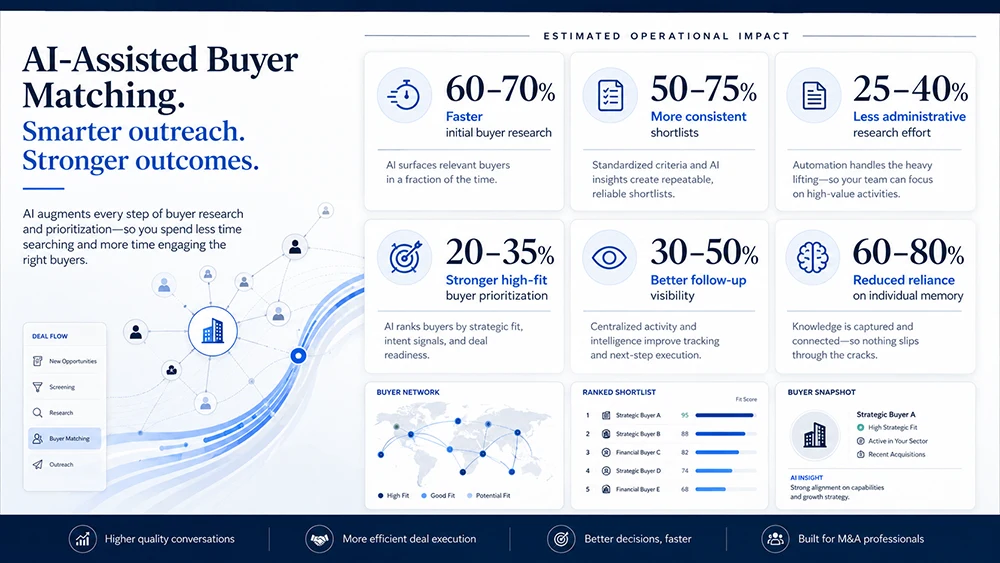
- Reduced buyer research time by an estimated 60–70% by replacing manual spreadsheet and inbox review with AI-assisted matching and ranked buyer recommendations.
- Improved shortlist consistency by an estimated 50–75% through standardized hard filters, weighted scoring, and repeatable buyer evaluation logic.
- Lowered administrative research effort by an estimated 25–40% by automating buyer filtering, scoring, explanation generation, and data organization.
- Strengthened high-fit buyer prioritization by an estimated 20–35% by ranking buyers based on industry fit, deal size, geography, EBITDA profile, acquisition history, and engagement signals.
- Improved follow-up visibility by an estimated 30–50% through centralized engagement tracking, including outreach activity, recency, NDA progress, LOI activity, and buyer response signals.
- Reduced reliance on individual memory by an estimated 60–80% by capturing buyer intelligence, match reasoning, review history, and activity inside a centralized production platform.
- Created a scalable digital operating model that helps advisors move faster from deal intake to qualified buyer outreach while maintaining human review and control.
- Turned AI into practical business leverage by using it inside the workflow, not as a gimmick, to help produce faster decisions, lower operating friction, and better execution.